
Google Stitch Pricing: Is it Really Free in 2026?

Google Stitch Pricing guide mentioning free plan, daily credit limits, and competitor price comparison.

Jump to

Title

Generate UI designs and wireframes with AI

Google Stitch pricing has been listed as free since its inception. Even Stitch 2.0 is free in 2026. I generated some screens to reveal the truth of Stitch credits and features in its free beta.

Google Stitch pricing has been listed as free since its inception. Even Stitch 2.0 is free in 2026. I generated some screens to reveal the truth of Stitch credits and features in its free beta.

Google Stitch is an AI UI Design Generator. It’s actually Galileo AI that was acquired by Google in mid-2025, and relaunched as Stitch by Google as a free beta. In March 2026, they upgraded it to Stitch 2.0 for Vibe Design — still free. (And still in the beta phase.) Sounds too good to be true? Did to me too. So I put on my product designer cap to dig deeper into Stitch credit plans, free features, and various modes by actually designing UI with Stitch AI. 

Read my full Google Stitch Review > 

Stitch 2.0 Pricing & Credits 2026 

Google Stitch free plan

400 design credits/day and 15 redesign credits/day.

Google Stitch free features

Multi-screen UI generation, latest Gemini models, voice canvas, prototyping, and Figma & code export

Google Stitch credit system

Complexity-based usage. Simple prompts/edits may cost ~3 credits, while multi-screen flows and edits can cost in double digits. 

Google Stitch competitor pricing

Strongest free value currently, but freemium AI design tools like Banani ($12/mo), Figma Make ($16/mo), and Lovable ($25/mo) offer paid scaling for teams and power users.

Google Stitch AI Pricing & Features

Google Stitch free plan in 2026
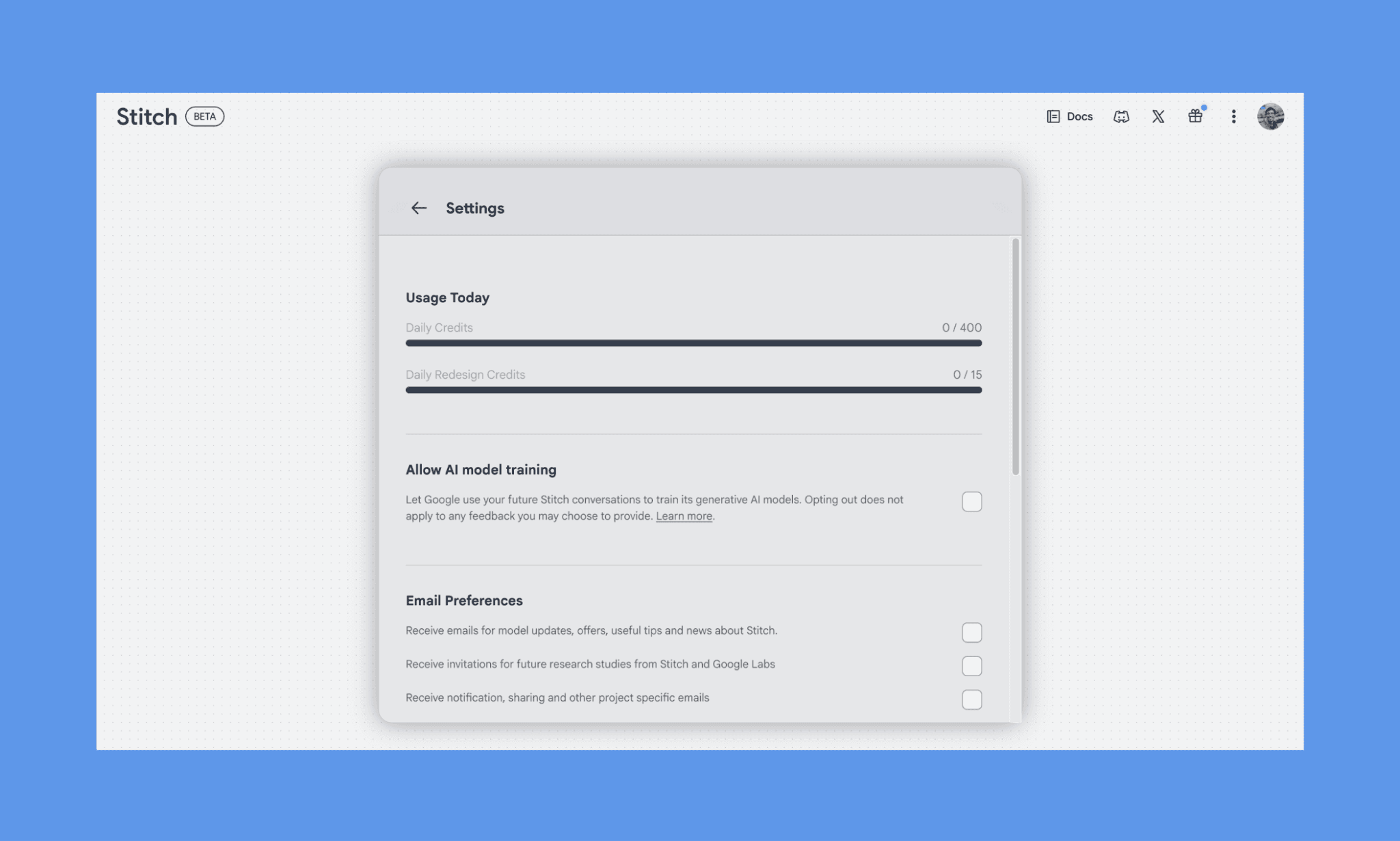
See the Google Stitch 2.0 daily credit limits from Settings.

Although Stitch AI is free, it operates on a credit-based usage. Earlier users were granted a total of 550 generations per month, split between two distinct modes: Sta

Standard Mode (350 generations/month) and Pro/Experimental Mode (200 generations/month). However, as of April 2026, Stitch 2.0 credits follow a daily (free) usage limit: 400 daily design credits and 15 daily redesign credits. Making a total of around 12,450 credits per month.  

The daily credits in Stitch reset at midnight UTC.

Google Stitch credits system in 2026

The credit system in Stitch by Google is not unitary; it is complexity-based instead. Meaning a simple ask like design me a “Single-pager portfolio for a front-end designer,” using Gemini 3.0 Flash, will cost 3 credits. But a more complex multi-screen app (like the one I generated in the later section) can cost in double digits. You can track your Stitch AI credits from: Profile → Stitch Settings. 

Further, any edits, prototype, planning, or the model you choose. decides the credit usage. However, given that multiple screens and edits can be generated/performed in one go, I still found it quite generous and useful. 

Google Stitch free features in 2026
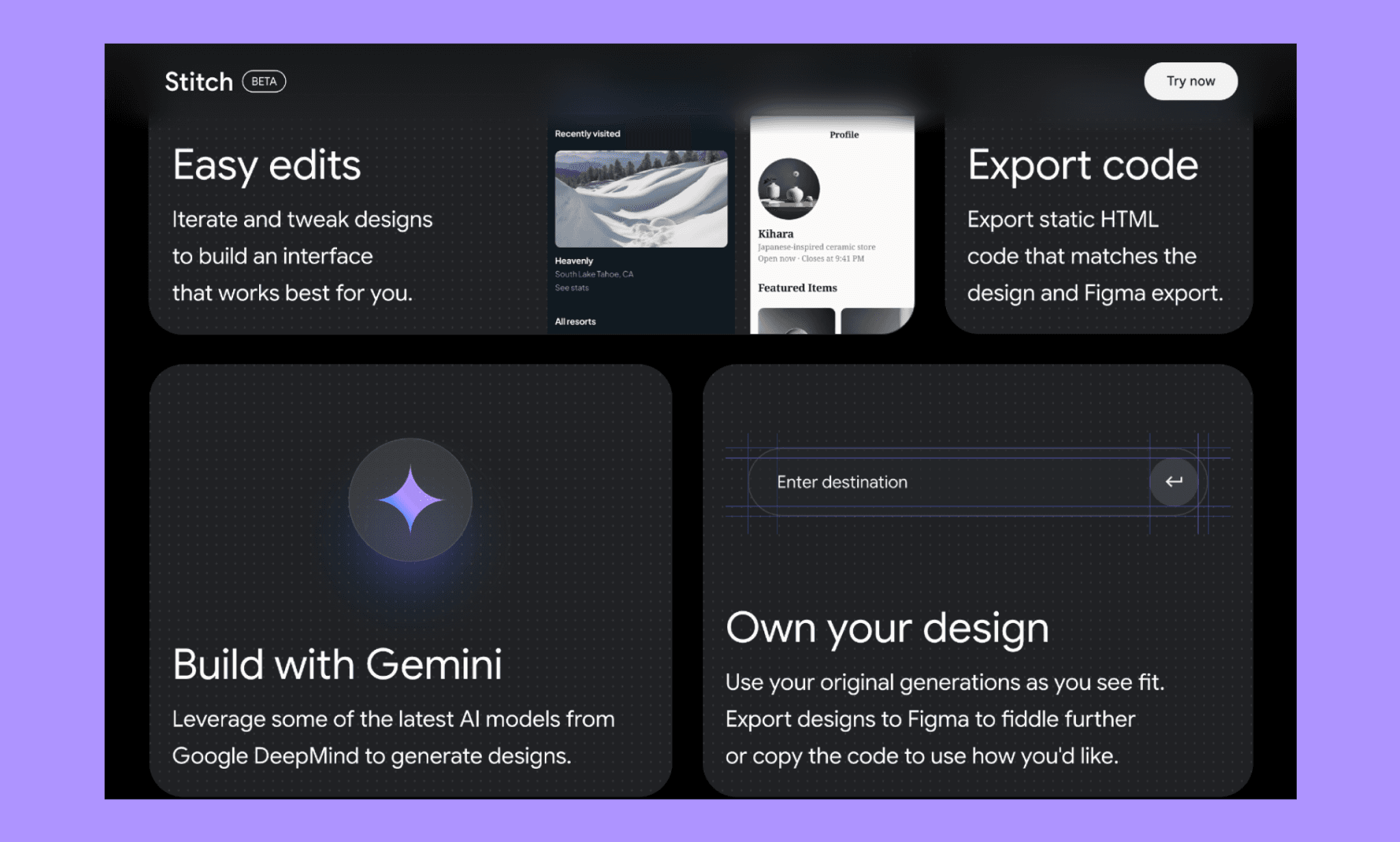
Key features of Stitch 2.0 includie multi-screen UI, prototyping, Figma integratoin, code export, and more.

The free beta of Google Stitch 2.0 includes several premium-style features at no cost during beta, which is rare in the AI design tool space.

  • Latest Gemini models: Choose Gemini 3 Flash, Gemini 3.1 Pro, or Nano Banani Pro for designing and editing UI.

  • Voice canvas: Use voice prompts to generate and refine UI concepts.

  • Code Export: Serving as a design-to-code AI, it lets you export React code or clean HTML/CSS with Tailwind support or export via MCP.

  • Figma Integration: Send designs to Figma with organized layers and Auto Layouts intact.

  • Design Systems Support – Import tokens, colors, and style rules. Stitch also creates a DESIGN.md file for reusable guidelines.

Google Stitch paid plan in 2026

As of April 2026, Google Stitch does not have any paid plans or subscription fees. Users need not even provide credit card information to access their AI UI Tool; a standard Google account is all that is required.

Stitch Free Plan UI Generation Test  
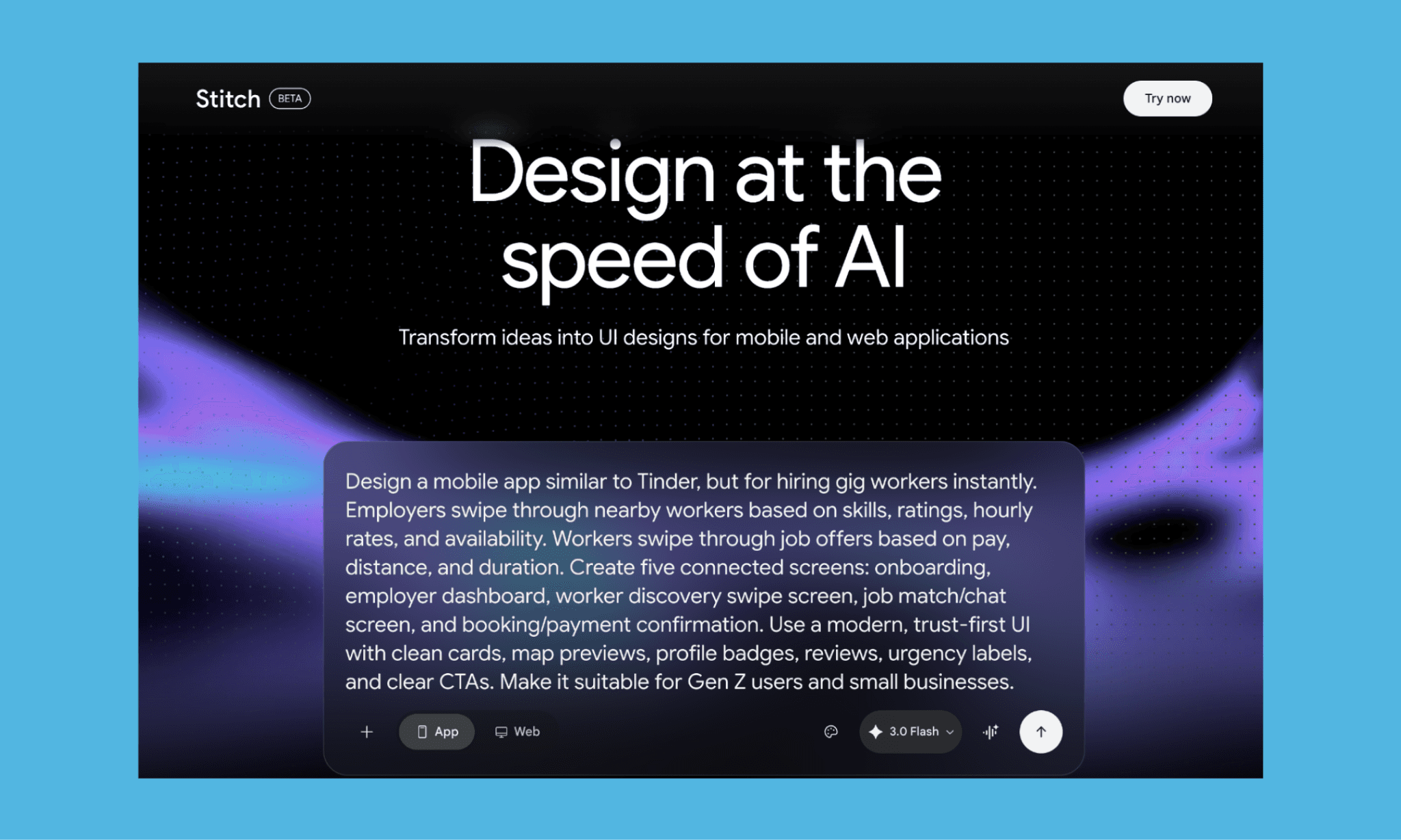
A test prompt to run in Google Stitch to see how its daily credit limits are used.

Now comes the time to test the invisible limits of Google Stitch’s free vibe designing software. I ran a complex real-world prompt with their superior model, viz. Gemini 3.1 PRO: a multi-screen gig hiring app with elements of Tinder UI, then followed it with edits and refinements to see how quickly credits drop under practical usage.

My prompt and UI generation 

"Design a mobile app similar to Tinder, but for hiring gig workers instantly. Employers swipe through nearby workers based on skills, ratings, hourly rates, and availability. Workers swipe through job offers based on pay, distance, and duration. Create five connected screens: onboarding, employer dashboard, worker discovery swipe screen, job match/chat screen, and booking/payment confirmation. Use a modern, trust-first UI with clean cards, map previews, profile badges, reviews, urgency labels, and clear CTAs. Make it suitable for Gen Z users and small businesses."
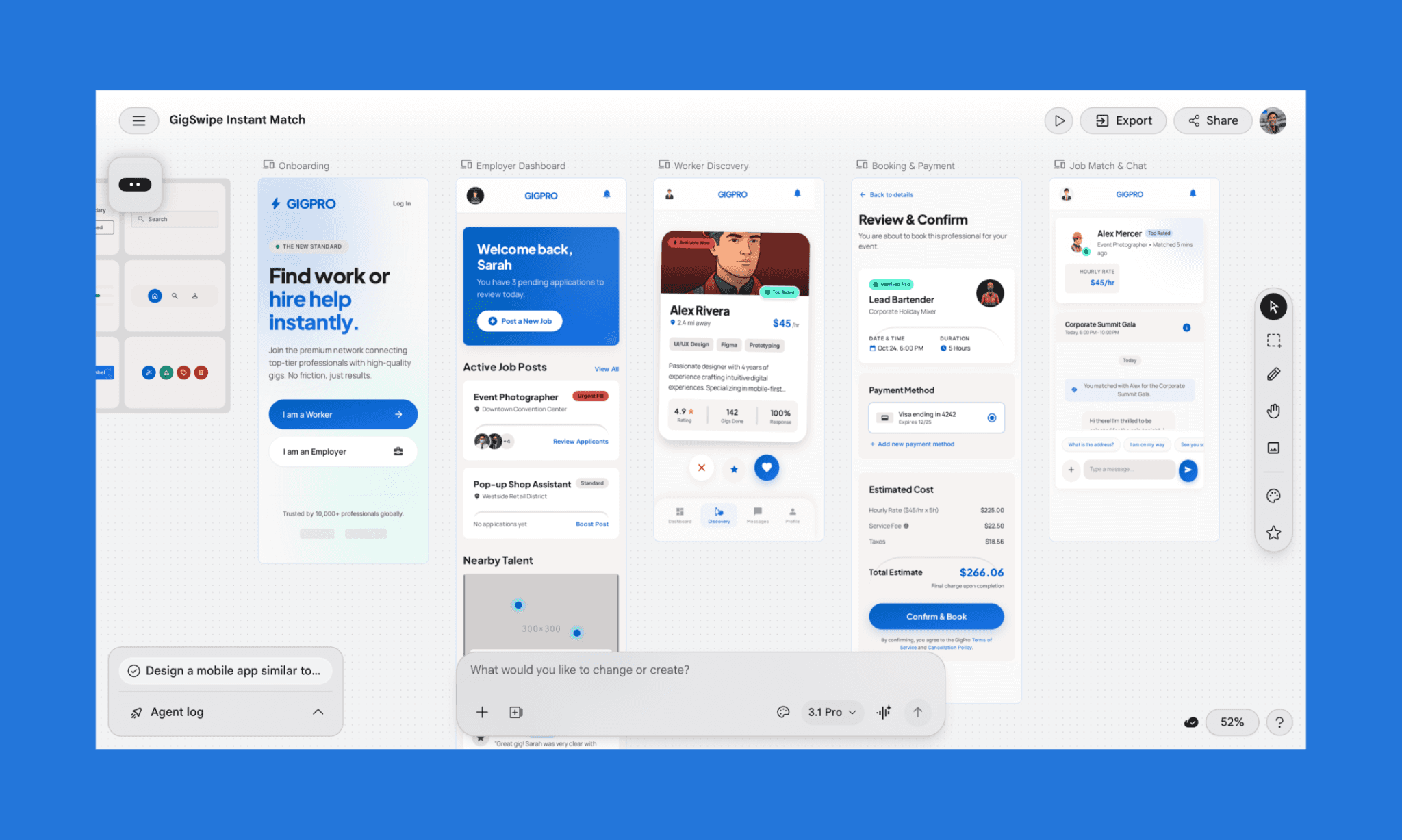
A multi-screen UI generated by Google Stitch that utilized 11 daily generation credit.

Stitch credit used: 11 daily credits

My UI edit and credit count

Then, I decided to redesign one of a single screen (on Worker Discovery) to see how the credits move. 
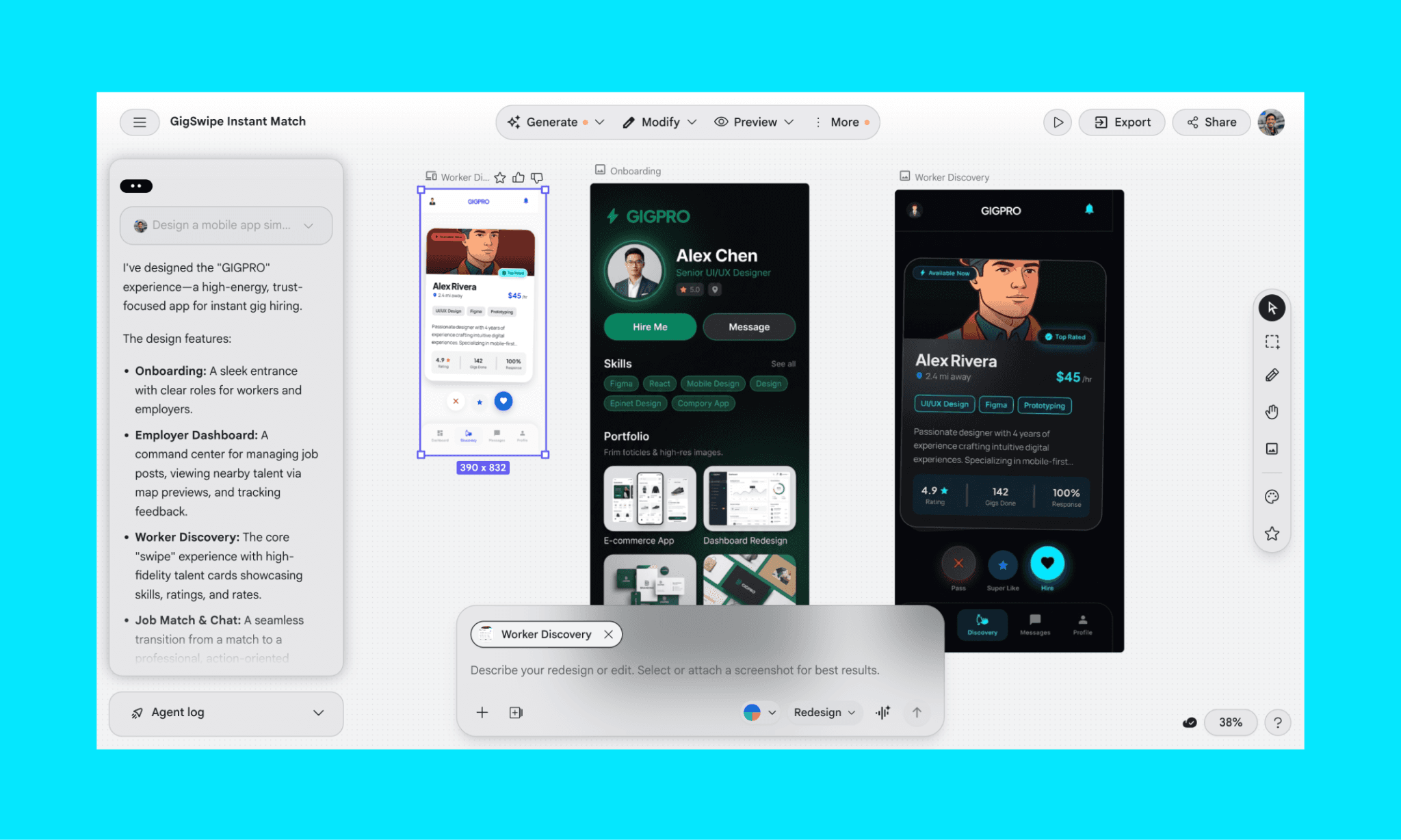
A single-screen UI regeneration or edit in Google Stitch costed 3 daily credits but no regeneration credits.

Stitch credit used: 3 daily credits

I was expecting the redesign credit to be utilized, but they were not; despite choosing Redesign mode. 

Also, as a side note, I was not happy with the redesign because it missed the point of a profile-swapping UI of dating apps. So, had to do it again, and this time too, 3 daily credits were used in UI edit; redesign edits were intact

Any Hidden Costs in Google Stitch?

Objectively speaking, no direct hidden fees in Google Stitch showed up in my testing. In fact, was pleasantly surprised to see that prototyping multiple screens through simple click-and-drag interactions did not consume credits. 

Yet, if coming down to practicals, there is a hidden cost of using Google Stitch: unpredictability of credits. Stitch does not clearly show how many credits a prompt will use before generation or provide any doc on it, making usage hard to budget. I also noticed redesign actions consumed standard daily credits instead of redesign credits, which makes the stated limits less transparent and slightly less useful.

Read about the hidden cost in Lovable AI >

Stitch Competitor Price Comparison 

Tool

Free Plan

Paid Plan (Starting)

Best For

Google Stitch

Free beta with 400 credits/day

and 15 redesign credits/day

None yet

Fast AI UI generation, prototyping, vibe design

Banani

~170 monthly credits

$20/mo for ~400 credits

Multi-screen app prototypes from text or images

Uizard

3 AI generations per month

with Autodesigner 1.5

$19/mo for 500 AI generations

Non-designers building MVP mockups

Figma Make

500 AI credits/month

(up to 150/day)

$20/mo for 3k AI credits

Pro designers needing collaboration systems

Lovable

30 credits/month

(up to 5/day)

$25/mo for 100 credits

Vibe coding an app

Bolt.new

1M tokens/month

(up to 30k/day)

$25/mo for 10M tokens

Full-stack AI app building

Claude Design

Beta usage limits

Usage-based / Pro tiers

Deep AI-native creative workflows

*Note: All pricing is monthly. Yearly rates of each tool are cheaper. 

Comparing Google Stitch pricing with its alternative AI for UI/UX Design in 2026, it’s clear that the fight is tilted: Google Stitch stands out on pure value because its beta remains free while offering features many competitors reserve for paid tiers. But as it's not sustainable, we shall have to revisit it in the coming time when the Stitch AI paid plan shows up.

Check out the top Google Stitch Alternatives in 2026 >

Is Stitch Free Beta Worth it? 

Google Stitch is one of the best zero-cost ways to explore AI-powered UI design in 2026, especially for solo founders, PMs, and early-stage teams validating ideas fast. But free access is not the same as dependable access. Credit usage is unpredictable, workflow controls still feel beta, and power users cannot buy credits. So, if you need a vibe design tool for production-ready multi-screen prototyping, whose credit usage is transparent and affordable to top up, Banani is the smarter long-term pick.

FAQs on Google Stitch Pricing 

Is Stitch 2.0 free?

Yes, the Stitch 2.0 is currently free to use while it remains in its beta phase, as was the initial Stitch version. However, it has daily credit limitations. 

Is Stitch fully free?

While Stitch has no paid plans, subscription fees, or credit card requirements, it is not fully free either. It operates on a credit-based system to manage daily usage.

Does Google Stitch have a limit?

Yes. Since March 2026, the latest limits of Google Stitch usage are around ~12.5k credits per month. It includes 400 design credits and 15 redesign credits on a daily basis.

Can I buy credits in Google Stitch AI?

No, currently, there is no way to buy credits in Google Stitch AI. Just cannot top up credits or upgrade subscription. Users who reach their limit must wait for their Stitch credits to reset at midnight UTC.

Will Google Stitch release a paid plan?

Plausibly, yes. Google has not made an official announcement, but knowing that it's been in beta for almost a year, and also economically unsustainable to keep free forever, one can imagine them releasing a paid plan in the coming time. 

What is the best free alternative to Google Stitch AI?

Banani is widely considered the top alternative to Google Stitch, both in features and cost. Banani AI offers multi-screen generation, Gemini models, Figma export, and more like Google Stitch with a generous free plan of ~170 credits/month. And you can top up your Banani credits anytime (unlike Stitch AI) for as low as $12. 

Google Stitch is an AI UI Design Generator. It’s actually Galileo AI that was acquired by Google in mid-2025, and relaunched as Stitch by Google as a free beta. In March 2026, they upgraded it to Stitch 2.0 for Vibe Design — still free. (And still in the beta phase.) Sounds too good to be true? Did to me too. So I put on my product designer cap to dig deeper into Stitch credit plans, free features, and various modes by actually designing UI with Stitch AI. 

Read my full Google Stitch Review > 

Stitch 2.0 Pricing & Credits 2026 

Google Stitch free plan

400 design credits/day and 15 redesign credits/day.

Google Stitch free features

Multi-screen UI generation, latest Gemini models, voice canvas, prototyping, and Figma & code export

Google Stitch credit system

Complexity-based usage. Simple prompts/edits may cost ~3 credits, while multi-screen flows and edits can cost in double digits. 

Google Stitch competitor pricing

Strongest free value currently, but freemium AI design tools like Banani ($12/mo), Figma Make ($16/mo), and Lovable ($25/mo) offer paid scaling for teams and power users.

Google Stitch AI Pricing & Features

Google Stitch free plan in 2026

See the Google Stitch 2.0 daily credit limits from Settings.

Although Stitch AI is free, it operates on a credit-based usage. Earlier users were granted a total of 550 generations per month, split between two distinct modes: Sta

Standard Mode (350 generations/month) and Pro/Experimental Mode (200 generations/month). However, as of April 2026, Stitch 2.0 credits follow a daily (free) usage limit: 400 daily design credits and 15 daily redesign credits. Making a total of around 12,450 credits per month.  

The daily credits in Stitch reset at midnight UTC.

Google Stitch credits system in 2026

The credit system in Stitch by Google is not unitary; it is complexity-based instead. Meaning a simple ask like design me a “Single-pager portfolio for a front-end designer,” using Gemini 3.0 Flash, will cost 3 credits. But a more complex multi-screen app (like the one I generated in the later section) can cost in double digits. You can track your Stitch AI credits from: Profile → Stitch Settings. 

Further, any edits, prototype, planning, or the model you choose. decides the credit usage. However, given that multiple screens and edits can be generated/performed in one go, I still found it quite generous and useful. 

Google Stitch free features in 2026

Key features of Stitch 2.0 includie multi-screen UI, prototyping, Figma integratoin, code export, and more.

The free beta of Google Stitch 2.0 includes several premium-style features at no cost during beta, which is rare in the AI design tool space.

  • Latest Gemini models: Choose Gemini 3 Flash, Gemini 3.1 Pro, or Nano Banani Pro for designing and editing UI.

  • Voice canvas: Use voice prompts to generate and refine UI concepts.

  • Code Export: Serving as a design-to-code AI, it lets you export React code or clean HTML/CSS with Tailwind support or export via MCP.

  • Figma Integration: Send designs to Figma with organized layers and Auto Layouts intact.

  • Design Systems Support – Import tokens, colors, and style rules. Stitch also creates a DESIGN.md file for reusable guidelines.

Google Stitch paid plan in 2026

As of April 2026, Google Stitch does not have any paid plans or subscription fees. Users need not even provide credit card information to access their AI UI Tool; a standard Google account is all that is required.

Stitch Free Plan UI Generation Test  

A test prompt to run in Google Stitch to see how its daily credit limits are used.

Now comes the time to test the invisible limits of Google Stitch’s free vibe designing software. I ran a complex real-world prompt with their superior model, viz. Gemini 3.1 PRO: a multi-screen gig hiring app with elements of Tinder UI, then followed it with edits and refinements to see how quickly credits drop under practical usage.

My prompt and UI generation 

"Design a mobile app similar to Tinder, but for hiring gig workers instantly. Employers swipe through nearby workers based on skills, ratings, hourly rates, and availability. Workers swipe through job offers based on pay, distance, and duration. Create five connected screens: onboarding, employer dashboard, worker discovery swipe screen, job match/chat screen, and booking/payment confirmation. Use a modern, trust-first UI with clean cards, map previews, profile badges, reviews, urgency labels, and clear CTAs. Make it suitable for Gen Z users and small businesses."

A multi-screen UI generated by Google Stitch that utilized 11 daily generation credit.

Stitch credit used: 11 daily credits

My UI edit and credit count

Then, I decided to redesign one of a single screen (on Worker Discovery) to see how the credits move. 

A single-screen UI regeneration or edit in Google Stitch costed 3 daily credits but no regeneration credits.

Stitch credit used: 3 daily credits

I was expecting the redesign credit to be utilized, but they were not; despite choosing Redesign mode. 

Also, as a side note, I was not happy with the redesign because it missed the point of a profile-swapping UI of dating apps. So, had to do it again, and this time too, 3 daily credits were used in UI edit; redesign edits were intact

Any Hidden Costs in Google Stitch?

Objectively speaking, no direct hidden fees in Google Stitch showed up in my testing. In fact, was pleasantly surprised to see that prototyping multiple screens through simple click-and-drag interactions did not consume credits. 

Yet, if coming down to practicals, there is a hidden cost of using Google Stitch: unpredictability of credits. Stitch does not clearly show how many credits a prompt will use before generation or provide any doc on it, making usage hard to budget. I also noticed redesign actions consumed standard daily credits instead of redesign credits, which makes the stated limits less transparent and slightly less useful.

Read about the hidden cost in Lovable AI >

Stitch Competitor Price Comparison 

Tool

Free Plan

Paid Plan (Starting)

Best For

Google Stitch

Free beta with 400 credits/day

and 15 redesign credits/day

None yet

Fast AI UI generation, prototyping, vibe design

Banani

~170 monthly credits

$20/mo for ~400 credits

Multi-screen app prototypes from text or images

Uizard

3 AI generations per month

with Autodesigner 1.5

$19/mo for 500 AI generations

Non-designers building MVP mockups

Figma Make

500 AI credits/month

(up to 150/day)

$20/mo for 3k AI credits

Pro designers needing collaboration systems

Lovable

30 credits/month

(up to 5/day)

$25/mo for 100 credits

Vibe coding an app

Bolt.new

1M tokens/month

(up to 30k/day)

$25/mo for 10M tokens

Full-stack AI app building

Claude Design

Beta usage limits

Usage-based / Pro tiers

Deep AI-native creative workflows

*Note: All pricing is monthly. Yearly rates of each tool are cheaper. 

Comparing Google Stitch pricing with its alternative AI for UI/UX Design in 2026, it’s clear that the fight is tilted: Google Stitch stands out on pure value because its beta remains free while offering features many competitors reserve for paid tiers. But as it's not sustainable, we shall have to revisit it in the coming time when the Stitch AI paid plan shows up.

Check out the top Google Stitch Alternatives in 2026 >

Is Stitch Free Beta Worth it? 

Google Stitch is one of the best zero-cost ways to explore AI-powered UI design in 2026, especially for solo founders, PMs, and early-stage teams validating ideas fast. But free access is not the same as dependable access. Credit usage is unpredictable, workflow controls still feel beta, and power users cannot buy credits. So, if you need a vibe design tool for production-ready multi-screen prototyping, whose credit usage is transparent and affordable to top up, Banani is the smarter long-term pick.

FAQs on Google Stitch Pricing 

Is Stitch 2.0 free?

Yes, the Stitch 2.0 is currently free to use while it remains in its beta phase, as was the initial Stitch version. However, it has daily credit limitations. 

Is Stitch fully free?

While Stitch has no paid plans, subscription fees, or credit card requirements, it is not fully free either. It operates on a credit-based system to manage daily usage.

Does Google Stitch have a limit?

Yes. Since March 2026, the latest limits of Google Stitch usage are around ~12.5k credits per month. It includes 400 design credits and 15 redesign credits on a daily basis.

Can I buy credits in Google Stitch AI?

No, currently, there is no way to buy credits in Google Stitch AI. Just cannot top up credits or upgrade subscription. Users who reach their limit must wait for their Stitch credits to reset at midnight UTC.

Will Google Stitch release a paid plan?

Plausibly, yes. Google has not made an official announcement, but knowing that it's been in beta for almost a year, and also economically unsustainable to keep free forever, one can imagine them releasing a paid plan in the coming time. 

What is the best free alternative to Google Stitch AI?

Banani is widely considered the top alternative to Google Stitch, both in features and cost. Banani AI offers multi-screen generation, Gemini models, Figma export, and more like Google Stitch with a generous free plan of ~170 credits/month. And you can top up your Banani credits anytime (unlike Stitch AI) for as low as $12. 

Generate UI designs using AI

Convert your ideas into beautiful and user-friendly designs. Fast and easy.